PLEASE READ ALL OF IT AND ANSWER THE QUESTIONS
Order of Operations

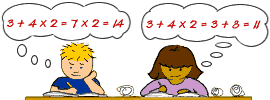 Problem: Evaluate the following arithmetic expression:
3 + 4 x 2
Solution:
| Student 1 | Student 2 | |||
| 3 + 4 x 2 | 3 + 4 x 2 | |||
| = 7 x 2 | = 3 + 8 | |||
| = 14 | = 11 |
It seems that each student interpreted the problem differently, resulting in two different answers. Student 1 performed the operation of addition first, then multiplication; whereas student 2 performed multiplication first, then addition. When performing arithmetic operations there can be only one correct answer. We need a set of rules in order to avoid this kind of confusion. Mathematicians have devised a standard order of operations for calculations involving more than one arithmetic operation.
Rule 1: First perform any calculations inside parentheses.
Rule 2: Next perform all multiplications and divisions, working from left to right.
Rule 3: Lastly, perform all additions and subtractions, working from left to right.
The above problem was solved correctly by Student 2 since she followed Rules 2 and 3. Let's look at some examples of solving arithmetic expressions using these rules.
Example 1: Evaluate each expression using the rules for order of operations.
Solution:
| Order of Operations | ||
| Expression | Evaluation | Operation |
| 6 + 7 x 8 | = 6 + 7 x 8 | Multiplication |
| = 6 + 56 | Addition | |
| = 62 | ||
| 16 ÷ 8 - 2 | = 16 ÷ 8 - 2 | Division |
| = 2 - 2 | Subtraction | |
| = 0 | ||
| (25 - 11) x 3 | = (25 - 11) x 3 | Parentheses |
| = 14 x 3 | Multiplication | |
| = 42 | ||
In Example 1, each problem involved only 2 operations. Let's look at some examples that involve more than two operations.
Example 2: Evaluate 3 + 6 x (5 + 4) ÷ 3 - 7 using the order of operations.
Solution:
| Step 1: | 3 + 6 x (5 + 4) ÷ 3 - 7 | = | 3 + 6 x 9 ÷ 3 - 7 | Parentheses |
| Step 2: | 3 + 6 x 9 ÷ 3 - 7 | = | 3 + 54 ÷ 3 - 7 | Multiplication |
| Step 3: | 3 + 54 ÷ 3 - 7 | = | 3 + 18 - 7 | Division |
| Step 4: | 3 + 18 - 7 | = | 21 - 7 | Addition |
| Step 5: | 21 - 7 | = | 14 | Subtraction |
Example 3: Evaluate 9 - 5 ÷ (8 - 3) x 2 + 6 using the order of operations.
Solution:
| Step 1: | 9 - 5 ÷ (8 - 3) x 2 + 6 | = | 9 - 5 ÷ 5 x 2 + 6 | Parentheses |
| Step 2: | 9 - 5 ÷ 5 x 2 + 6 | = | 9 - 1 x 2 + 6 | Division |
| Step 3: | 9 - 1 x 2 + 6 | = | 9 - 2 + 6 | Multiplication |
| Step 4: | 9 - 2 + 6 | = | 7 + 6 | Subtraction |
| Step 5: | 7 + 6 | = | 13 | Addition |
In Examples 2 and 3, you will notice that multiplication and division were evaluated from left to right according to Rule 2. Similarly, addition and subtraction were evaluated from left to right, according to Rule 3.
When two or more operations occur inside a set of parentheses, these operations should be evaluated according to Rules 2 and 3. This is done in Example 4 below.
Example 4: Evaluate 150 ÷ (6 + 3 x 8) - 5 using the order of operations.
Solution:
| Step 1: | 150 ÷ (6 + 3 x 8) - 5 | = | 150 ÷ (6 + 24) - 5 | Multiplication inside Parentheses |
| Step 2: | 150 ÷ (6 + 24) - 5 | = | 150 ÷ 30 - 5 | Addition inside Parentheses |
| Step 3: | 150 ÷ 30 - 5 | = | 5 - 5 | Division |
| Step 4: | 5 - 5 | = | 0 | Subtraction |
IN YOUR OWN WORDS WRITE YOUR DEFINITION OF
ADD/ADDITION
SUBSTRACT/SUBSTRACTION
MULTIPLY/MULTIPLICATION
DIVIDE/DIVISION
PARENTHESES
ORDER OF OPERATIONS

No hay comentarios.:
Publicar un comentario